

The Rural Charter Funding Gap: When 100 Students Still Is Not Enough
Indiana’s new local-revenue framework is an important step toward correcting the long-standing gap between charter schools and traditional public schools. But the design may produce a serious unintended consequence: some small rural charter schools could receive no local property-tax revenue even when their total enrollment exceeds 100 students.
The problem is not necessarily lack of demand. It is the geography of legal settlement.
By Kevin Davis | October 9, 2026 | Updated through the 2026 Indiana Code
Key Takeaways
- A rural charter school can have an actual ADM of 100 and still receive no local operations revenue.
- The corporation-level threshold rewards geographic concentration, while rural enrollment is often dispersed.
- The $1,400 grant may be the only broad mechanism recognizing the local-revenue gap for schools that clear no corporation threshold.
- Any grant redesign should be tested school by school against actual legal-settlement distributions.
- Public projections should identify schools receiving zero local revenue and explain why.
Download the rural funding-gap brief (PDF)
Important disclaimer: This publication is provided for educational and planning purposes only. It reflects Indiana Charters’ interpretation of Indiana law and publicly available guidance as of October 9, 2026, and has not been reviewed by legal counsel. It is not legal, tax, election-law, or accounting advice and does not create an attorney-client relationship. Statutes, appropriations, agency guidance, student data, and local calculations may change. Schools should verify requirements with the appropriate state or local agency and consult qualified professional counsel when making legal, referendum, advocacy, compliance, or budget decisions.
A statewide reform can have very different local results
The operations property-tax framework tests eligibility corporation by corporation. For each school corporation, the aggregate number of qualifying charter students must equal at least the greater of:
- 100 students; or
- 2% of the corporation’s spring average daily membership.
The qualifying count excludes virtual charter schools and students receiving more than 50% virtual instruction. If the corporation-level threshold is met, the statute then uses qualifying fall-ADM counts in the proportional allocation formula. (Ind. Code § 20-46-8-12.)
In an urban area, several charter schools may draw large numbers of students from one school corporation. Their students are aggregated, making the threshold easier to reach.
A rural charter school often operates in the opposite environment. It may draw smaller groups of students from several surrounding corporations. No single corporation may reach the threshold, and there may be no nearby charter schools whose students can be added to the count.
The school can therefore be successful, fully enrolled, and locally rooted—and still receive $0 under the new local-revenue formula.
A simple example
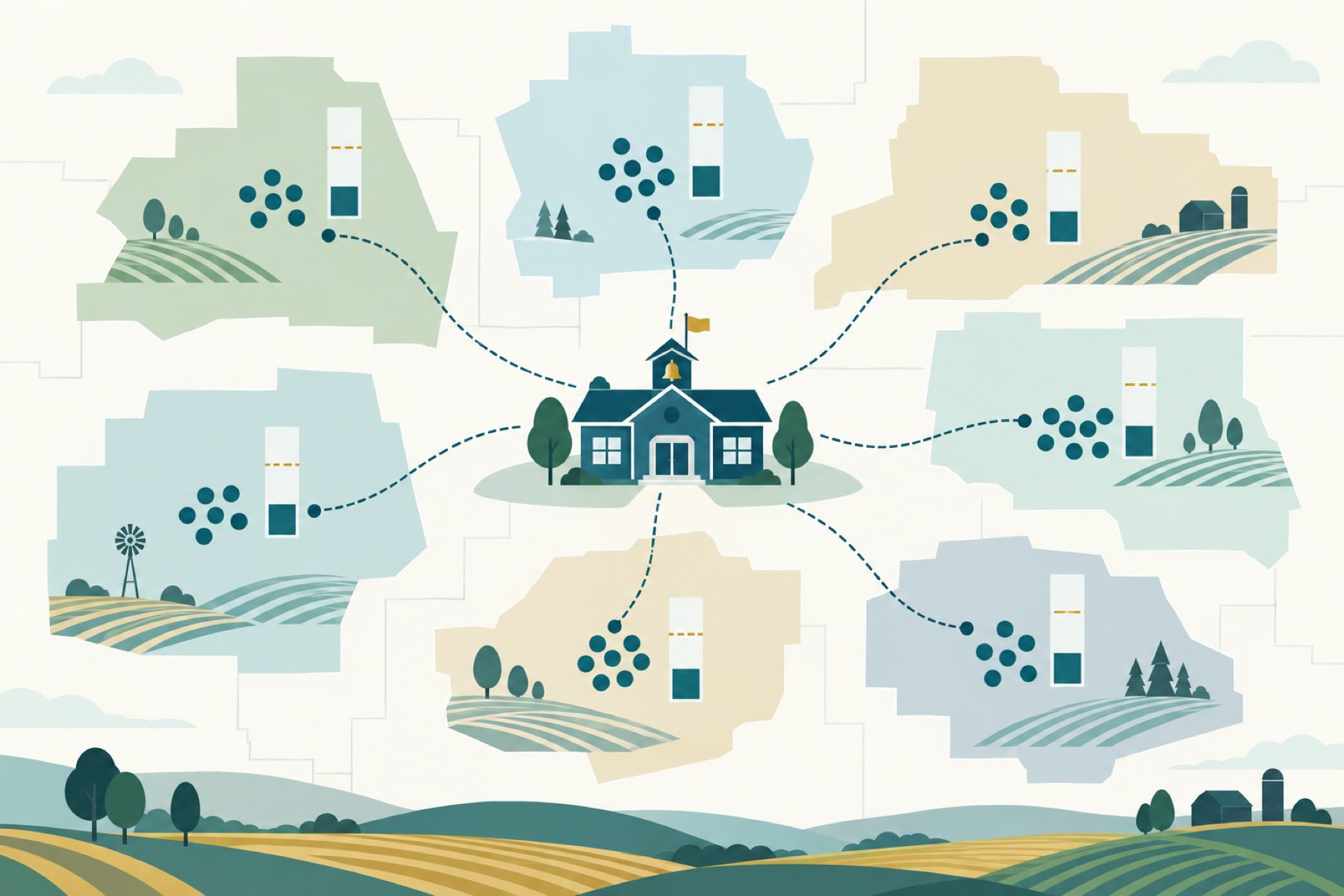
Consider a rural charter school with an actual ADM of 100 distributed across seven school corporations. Its students are geographically dispersed, and the school’s own enrollment does not reach 100 in any single corporation.
The school has an ADM of 100. But the statute does not combine those students across all corporations for purposes of the threshold.
If no other qualifying charter students bring Corporation A’s aggregate to its applicable threshold—and none of the other corporations reaches its own threshold—the school receives no operations property-tax share.
This is the rural funding gap in one sentence: the law recognizes aggregate charter enrollment within a corporation, but not a charter school’s aggregate public enrollment across corporations.
Why this matters beyond one school
Rural charter schools may serve communities where:
- student populations are geographically dispersed;
- surrounding school corporations are small;
- another charter school is many miles away;
- transportation patterns cross corporation boundaries;
- local tax bases are limited; and
- the school lacks the scale and philanthropic network available in larger cities.
These schools also face fixed costs that do not shrink in direct proportion to enrollment: leadership, audit, insurance, data systems, facilities, special education, transportation, cybersecurity, and state reporting.
A formula that produces new revenue primarily where charter enrollment is geographically concentrated could widen the resource gap between urban and rural charter schools even while increasing charter funding overall.
The $1,400 grant is the critical bridge
The Charter and Innovation Network School Grant currently provides $1,400 per eligible pupil to qualifying schools that do not receive a pro rata share of local property-tax revenue.
For a rural school that cannot satisfy a corporation-level threshold, this grant is not merely supplemental. It may be the only broadly available funding mechanism that partially recognizes the school’s lack of local property-tax support.
That is why any proposal to reduce or eliminate the grant must be evaluated school by school. A statewide total showing increased charter funding would not answer the essential question. The relevant test is whether each school’s combined grant and local revenue rises or falls.
Without that analysis, Indiana could unintentionally replace a broadly available per-pupil grant with a geographically uneven revenue stream—and discover too late that rural schools were left behind.
What the state should publish
Before changing the grant, Indiana should model the new system using actual legal-settlement distributions and publish:
- Each charter school’s students by corporation of legal settlement;
- Each corporation’s 100-or-2% threshold;
- Aggregate qualifying charter enrollment in each corporation;
- The school’s projected operations property-tax distribution by year;
- The school’s projected referendum eligibility, shown separately;
- The $1,400 grant amount under current law;
- The combined gain or loss under each proposed grant policy; and
- A list of schools projected to receive no local revenue, with the reason.
Student privacy can be protected because the public analysis needs only aggregate counts.
Questions legislators should answer
- Is it the General Assembly’s intent that a charter school with more than 100 total students can receive no local revenue because those students live in multiple corporations?
- How many charter schools are projected to receive $0 under the operations sharing formula?
- Are rural schools disproportionately represented in that group?
- Will the $1,400 grant continue for schools that receive no local revenue?
- If a school receives a small local distribution, will it lose a larger grant amount?
- Will the state guarantee that no school is worse off during the transition?
- Should there be an alternative pathway for geographically dispersed schools?
- When will school-level estimates be published, and what data will schools use to verify them?
These are not arguments against property-tax sharing. They are the questions needed to make the reform work for every kind of charter school.
Potential policy safeguards
Several approaches deserve modeling before the next budget is adopted:
Hold-harmless protection
Guarantee that a school’s combined local revenue and state grant will not fall below a defined baseline during the transition.
A continuing grant for schools receiving no local share
Preserve the $1,400 grant, or a successor amount, for schools that do not qualify for local revenue in any corporation.
A partial grant offset instead of a cliff
Reduce grant funding only in relation to actual local revenue received, avoiding a situation in which a small local payment causes a larger net loss.
An alternative rural or dispersed-enrollment test
Create a pathway based on a charter school’s total enrollment or documented multi-corporation service area when no corporation-level aggregate crosses the threshold.
Required public impact reporting
Direct IDOE to publish annual school-level estimates, actual distributions, grant offsets, and explanations for zero-dollar outcomes.
How to raise the issue constructively
The strongest message is not that urban charter advocates or policymakers acted in bad faith. The stronger case is that a corporation-based formula may have an unmeasured geographic effect.
The coalition-building question is:
Before changing the grant, can Indiana agree to run the formula against every charter school’s actual legal-settlement distribution and ensure the transition does not unintentionally disadvantage rural students?
That framing invites authorizers, charter advocates, traditional districts, fiscal leaders, and legislators to solve a design problem together.
What rural charter leaders should do now
- Maintain accurate legal-settlement data by corporation.
- Estimate the applicable threshold for every significant sending corporation.
- Identify other qualifying charter enrollment within those corporations.
- Model the school’s 2028–2031 local revenue under conservative assumptions.
- Keep the $1,400 grant and local revenue on separate budget lines.
- Brief the board on both the opportunity and the zero-revenue risk.
- Share aggregate, privacy-protected examples with legislators before the next budget debate.
Continue the series
- Indiana Charter School Property-Tax Sharing: What SEA 1 Changes—and What It Does Not Guarantee
- How Indiana Charter Schools Can Participate in Local Referenda
Sources and important limitation
- Indiana Code § 20-46-8-12 (operations property-tax sharing, corporation-level threshold, allocation, and phase-in)
- Indiana Code §§ 20-46-1-21 and 20-46-1-22 (separate operating-referendum provisions)
- Indiana Code §§ 20-24-13-1 and 20-24-13-6 (grant-program applicability and statutory grant calculation)
- DLGF, *Legislative Changes to Property Tax Referenda and Controlled Projects* (June 10, 2025)
This publication has not been reviewed by legal counsel and is not legal, tax, election-law, or accounting advice. Projected outcomes should be updated as IDOE guidance, official estimates, appropriations, and student counts become available.
Turn the Rural Funding Question Into Verifiable Data
Indiana Charters can help rural schools model corporation-level eligibility, document the potential gap, and prepare privacy-protected board and policy materials.