

Indiana Charter School Property-Tax Sharing: What SEA 1 Changes—and What It Does Not Guarantee
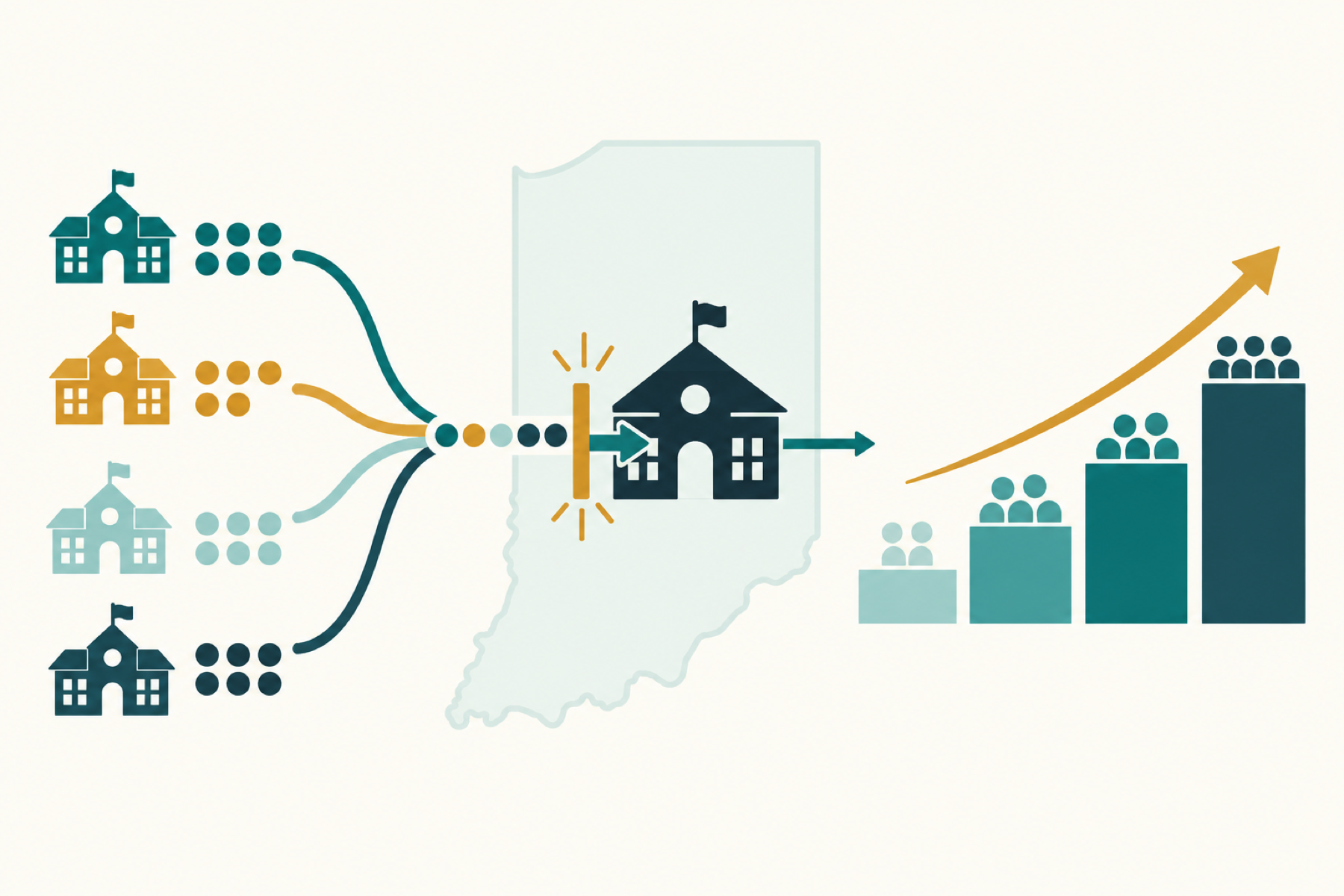
Indiana’s 2025 school-funding changes created a major new opportunity for charter schools: beginning with property-tax collections after December 31, 2027, qualifying charter schools can receive a share of certain local operations revenue.
That headline is accurate—but incomplete.
The law does not provide an equal payment to every charter school. Eligibility depends on where students have legal settlement, how many qualifying charter students are connected to each school corporation, the corporation’s spring average daily membership, and the amount of qualifying revenue actually collected. If the threshold is met, the later allocation calculation uses qualifying fall-ADM counts. The new revenue also phases in over four years. (Ind. Code § 20-46-8-12.)
For school leaders and boards, the practical lesson is simple: do not treat property-tax sharing as guaranteed revenue merely because a school enrolls more than 100 students.
By Kevin Davis | October 9, 2026 | Updated through the 2026 Indiana Code
Key Takeaways
- Operations property-tax sharing begins with qualifying collections after December 31, 2027 and phases in from 25% to 100% through 2031.
- Eligibility is tested by school corporation using the greater of 100 qualifying charter students or 2% of spring ADM.
- A charter school's total enrollment does not establish eligibility; legal-settlement concentration and aggregate charter enrollment matter.
- The $1,400 state grant and local operations revenue should remain separate in forecasts and accounting records.
- Schools should wait for reliable corporation-level data or official IDOE estimates before treating local revenue as supportable budget revenue.
Download the property-tax sharing guide (PDF)
Important disclaimer: This publication is provided for educational and planning purposes only. It reflects Indiana Charters’ interpretation of Indiana law and publicly available guidance as of October 9, 2026, and has not been reviewed by legal counsel. It is not legal, tax, election-law, or accounting advice and does not create an attorney-client relationship. Statutes, appropriations, agency guidance, student data, and local calculations may change. Schools should verify requirements with the appropriate state or local agency and consult qualified professional counsel when making legal, referendum, advocacy, compliance, or budget decisions.
When does operations property-tax sharing begin?
The statewide framework applies to qualifying property-tax collections after December 31, 2027. The charter-school share phases in as follows under Ind. Code § 20-46-8-12:
- 2028: 25% of the calculated share
- 2029: 50%
- 2030: 75%
- 2031 and later: 100%
The Indiana Department of Education is required to provide estimates beginning August 15, 2027, and annually thereafter. Those estimates should become the principal source for a school’s near-term budget assumptions.
Until an official estimate is available, schools should treat any projected amount as a scenario—not a receivable.
What is the “100 students or 2%” rule?
The statute uses the greater of two thresholds:
- 100 qualifying charter-school students with legal settlement in the school corporation; or
- 2% of the school corporation’s spring average daily membership.
“Greater of” matters. The operative threshold is whichever number is higher.
For example:
- If 2% of a corporation’s spring membership is 60 students, the threshold is 100.
- If 2% is 140 students, the threshold is 140.
This is not generally a test of whether one charter school enrolls 100 students in total. It is a corporation-level test based on the aggregate number of qualifying charter students whose legal settlement is in that particular corporation. Virtual charter schools are excluded, as are students who receive more than 50% of their instruction virtually. (Ind. Code § 20-46-8-12.)
Are students combined across multiple charter schools?
Yes—when they share legal settlement in the same school corporation and otherwise qualify under the statute.
Suppose Corporation A has:
- 65 resident students attending Charter School One;
- 25 attending Charter School Two; and
- 15 attending Charter School Three.
The corporation-level total is 105. If the applicable threshold is 100, the aggregate qualifies even though none of the three charter schools independently enrolls 100 students from Corporation A.
The reverse is equally important. A charter school may enroll 105 students overall but have them distributed across several school corporations. If no corporation’s aggregate qualifying charter enrollment reaches its applicable threshold, the charter school may receive no operations property-tax distribution.
Why the amount cannot be known from enrollment alone
Crossing the threshold establishes access to a calculation; it does not establish a fixed dollar amount. The threshold uses aggregate qualifying charter enrollment and the corporation’s spring membership; the allocation formula then uses qualifying fall-ADM counts. Actual revenue depends on several moving parts:
- the student’s corporation of legal settlement;
- the total number of qualifying charter students tied to that corporation;
- the corporation’s spring membership and resulting threshold;
- the qualifying operations levy and actual collections;
- each charter school’s proportional share based on the statutory fall-ADM calculation; and
- the statutory phase-in percentage for the year.
Two charter schools with identical enrollment can therefore receive very different amounts. Geography and student distribution matter as much as total headcount.
What happens to the $1,400 Charter and Innovation Network School Grant?
Indiana Code currently provides $1,400 per eligible pupil through the Charter and Innovation Network School Grant program. The program applies to eligible schools that do not receive a pro rata share of local property-tax revenue.
The existence of the new property-tax framework raises an obvious policy question: will the $1,400 grant continue unchanged, be reduced, or be redesigned as local revenue expands?
The present statutes should not be read as a long-term guarantee that every school will receive both revenue streams in full. Nor should anyone assume that a future reduction in the grant would be offset dollar-for-dollar by local property-tax revenue. Some schools—particularly small or rural schools—may receive little or no local revenue because their students are spread among several corporations.
That makes the interaction between the two funding sources one of the most important issues for future legislative sessions.
How should a charter school budget this revenue?
Keep the funding streams separate. A practical chart of accounts and forecast should use distinct revenue lines for:
- Charter and Innovation Network School Grant;
- operations property-tax sharing; and
- referendum distributions.
Then use a three-case forecast:
Conservative case
- Budget the grant only to the extent supported by enacted appropriations and current eligibility.
- Budget no property-tax sharing until the school has reliable corporation-level data or an official IDOE estimate.
- Budget no referendum revenue unless the referendum and participation requirements are established.
Planning case
- Use current legal-settlement counts by corporation.
- Estimate each corporation’s applicable threshold.
- Apply the statutory phase-in percentage.
- Discount the result for collection and data uncertainty.
Official-estimate case
- Replace internal scenarios with the annual IDOE estimate when available.
- Reconcile the estimate to the school’s own student-level legal-settlement data.
- Document all assumptions for the board and any budget amendment.
Schools should avoid plugging a statewide per-pupil average into the revenue line. The law does not operate as a uniform statewide per-pupil payment.
Questions school leaders should ask now
- How many current students are assigned to each corporation of legal settlement?
- What is each corporation’s spring membership?
- What is the greater-of threshold for each corporation?
- How many qualifying charter students—across all eligible charter schools—are connected to that corporation?
- What qualifying operations revenue does the corporation expect to collect?
- How will the $1,400 grant interact with local revenue in future budgets?
- What happens to schools that do not cross a threshold in any single corporation?
The policy question Indiana should answer before changing the grant
Before the state reduces or redesigns the $1,400 grant, policymakers should publish a school-by-school analysis showing:
- projected local revenue;
- schools projected to receive no local revenue;
- the legal-settlement and threshold reason for each outcome; and
- whether the combined state and local funding produces a net gain or loss.
That analysis would turn an abstract funding debate into a measurable question: does the new system improve funding for every type of charter school, or only for schools whose enrollment is sufficiently concentrated within particular corporations?
Continue the series
- How Indiana Charter Schools Can Participate in Local Referenda
- The Rural Charter Funding Gap: When 100 Students Still Is Not Enough
Sources and important limitation
- Indiana Code § 20-46-8-12 (statewide operations property-tax sharing, threshold, allocation, phase-in, and estimates)
- Indiana Code §§ 20-24-13-1 and 20-24-13-6 (grant-program applicability and statutory grant calculation)
- Indiana Code § 20-43-4-7.2 and related definitions and enrollment provisions
- DLGF, *Legislative Changes to Property Tax Referenda and Controlled Projects* (June 10, 2025)
This publication has not been reviewed by legal counsel and is not legal, tax, election-law, or accounting advice. Schools should confirm current law, official estimates, and applicable professional requirements before acting.
Model the Funding Effect Before It Reaches the Budget
Indiana Charters can help schools organize legal-settlement data, develop funding scenarios, and translate state estimates into board-ready budget assumptions.